
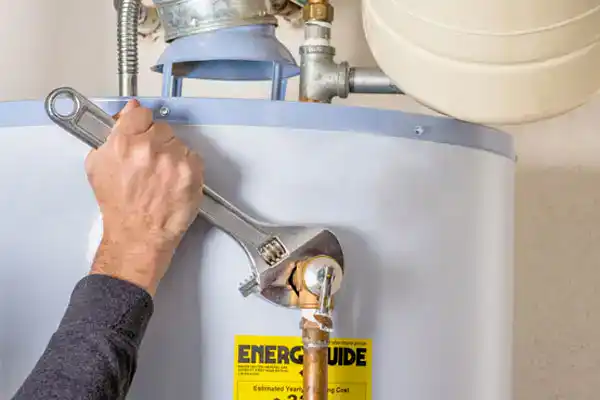
To start, Let’s be safe! ELECTRIC WATER HEATERS-SHUT OFF THE BREAKER -OR- GAS WATER HEATERS, SHUT OFF THE GAS SUPPLY AT THE VALVE BEFORE YOU BEGIN CHECKING: If you’ve lost hot water, the cause is usually one of a few things you can safely check: on a gas heater, a pilot or thermocouple that has gone out; on an electric one, a tripped breaker or a failed heating element. Lukewarm water that runs cold fast usually means a failing element or a tank full of sediment. Here’s the safe order to check before you call.
First, figure out what kind of heater you have
The checks differ by fuel. A gas water heater has a burner, a pilot or electronic igniter, and a gas control valve; an electric one has one or two heating elements and thermostats wired to a breaker. Look for a gas line and a small access panel near the bottom (gas) versus a conduit and no burner (electric). Knowing which you have decides where to look and what is safe to touch.
A word on safety before anything else: If you smell gas at any point, stop, leave the house, and call from outside. Do not flip switches or relight anything. That is not a water heater problem to troubleshoot—it is a gas emergency. For everything else below, the checks are homeowner-safe.
The safe triage order
Work down this list in order. Most lost-hot-water calls are solved in the first two or three steps, and the rest tell you clearly that it is time for water heater repair.
Check these before you call
- Electric: check the breaker. A tripped breaker is the most common cause; reset it once.
- Gas: check whether the pilot is lit (older units) or the igniter is working (newer units).
- Gas: if the pilot will not stay lit, the thermocouple is the usual culprit—a common repair.
- Both: confirm the thermostat setting has not been bumped down.
- Both: note whether you get lukewarm water that runs cold, which points to an element or sediment.
- If you see water pooling around the base, stop—the tank may be failing.
What each symptom usually means
The pattern of the failure narrows the cause. No hot water at all on a gas unit is most often the pilot or thermocouple; on an electric unit it is the breaker or an element. Hot water that runs out much faster than it used to often means one of two electric elements has failed, so you are running on half capacity, or that sediment has stolen tank volume. Rusty hot water points to the anode or the tank itself corroding.
| Symptom | Gas heater | Electric heater |
|---|---|---|
|
No hot water at all |
Pilot out / thermocouple / gas valve |
Tripped breaker / dead element |
|
Runs out fast |
Undersized or heavy sediment |
One of two elements failed |
|
Lukewarm only |
Burner or thermostat | Thermostat or element |
|
Rusty hot water |
Anode rod or tank corroding |
Anode rod or tank corroding |
| Water around the base |
Tank likely failing | Tank likely failing |
When it is a repair, and when it is the end of the tank
Most no-hot-water causes are genuine repairs: a thermocouple, a heating element, a thermostat, or a gas control valve are all repairable on a unit that otherwise has life left. If your heater is under about eight years old, fixing it is usually the right call. Water pooling around the base is the exception—a leaking tank is not repairable, and on an older unit that is the moment to plan a replacement before it fails completely.
If the heater is over ten years old and this is not the first problem, it is worth weighing repair against replacement rather than fixing one part at a time. And if you are replacing, it is the natural point to consider whether a tankless unit fits your household. Either way, describe the symptom when you call and a plumber can usually tell you over the phone whether it is likely a quick fix.
What to tell the plumber when you call
A few details on the phone let a plumber arrive with the right parts and often give you a sense of the fix before anyone is dispatched. Start with the basics: is the heater gas or electric, roughly how old is it, and is it a tank or tankless? Those three facts alone rule out half the possibilities and decide which parts are likely needed.
Then describe the symptom precisely, because the wording matters: “no hot water at all” points somewhere different than “hot water that runs out fast” or “lukewarm only.” Say what you have already checked, too. If the breaker was not tripped, the pilot would not relight, or the reset button did nothing, mention it so the plumber does not repeat your steps. And note whether you have seen any water around the base, which changes the visit from a repair to a possible replacement.
If you smell gas, that is the one thing not to troubleshoot on the phone: leave the house and call from outside, and treat it as an emergency rather than a water heater question. For every other symptom, the more specific you are, the more likely the plumber can tell you whether it is a quick fix and arrive ready to make it in one trip rather than two.
Talking to a licensed local plumber beats guessing. If the steps above do not restore your hot water, call Air & Plumbing Today at 210-519-5959 around San Antonio or 512-859-5959 around the Austin area and describe what is happening.
FAQ
Questions people ask
My pilot keeps going out, what is wrong?
The usual cause is a worn thermocouple, the safety sensor that keeps the gas valve open only while it senses the pilot flame. It is a common, inexpensive repair. If relighting per the instructions on the tank does not hold, that is the likely fix.
Why does my hot water run out so fast now?
On an electric heater, one of the two elements has often failed, leaving you on half capacity. On any heater, years of sediment can steal tank volume. Both are diagnosable, and sediment is worse on hard water common in the San Antonio and Austin areas.
Is it safe to relight a gas water heater myself?
Following the manufacturer’s lighting guidelines printed on the tank is generally safe. But if you smell gas at any point, stop, leave, and call from outside—do not relight or flip switches. A persistent gas smell is an emergency, not a DIY task.
Should I reset the breaker more than once?
Reset it once. If an electric heater’s breaker trips again immediately, something is wrong, often a shorted element, and repeatedly resetting it is unsafe. That is the point to call for a diagnosis.
What should I tell the plumber when I call about no hot water?
Say whether the heater is gas or electric, roughly its age, tank or tankless, the exact symptom (none, lukewarm, or runs out fast), what you already checked, and whether there is any water around the base. That lets them arrive with the right parts.
Need water heater repair in San Antonio or Austin?
Skip the guesswork. If the troubleshooting guide doesn’t restore your hot water, call Air & Plumbing Today at 210-519-5959 around San Antonio or 512-859-5959 around the Austin area.